Salisbury Plain, England
1000 BC
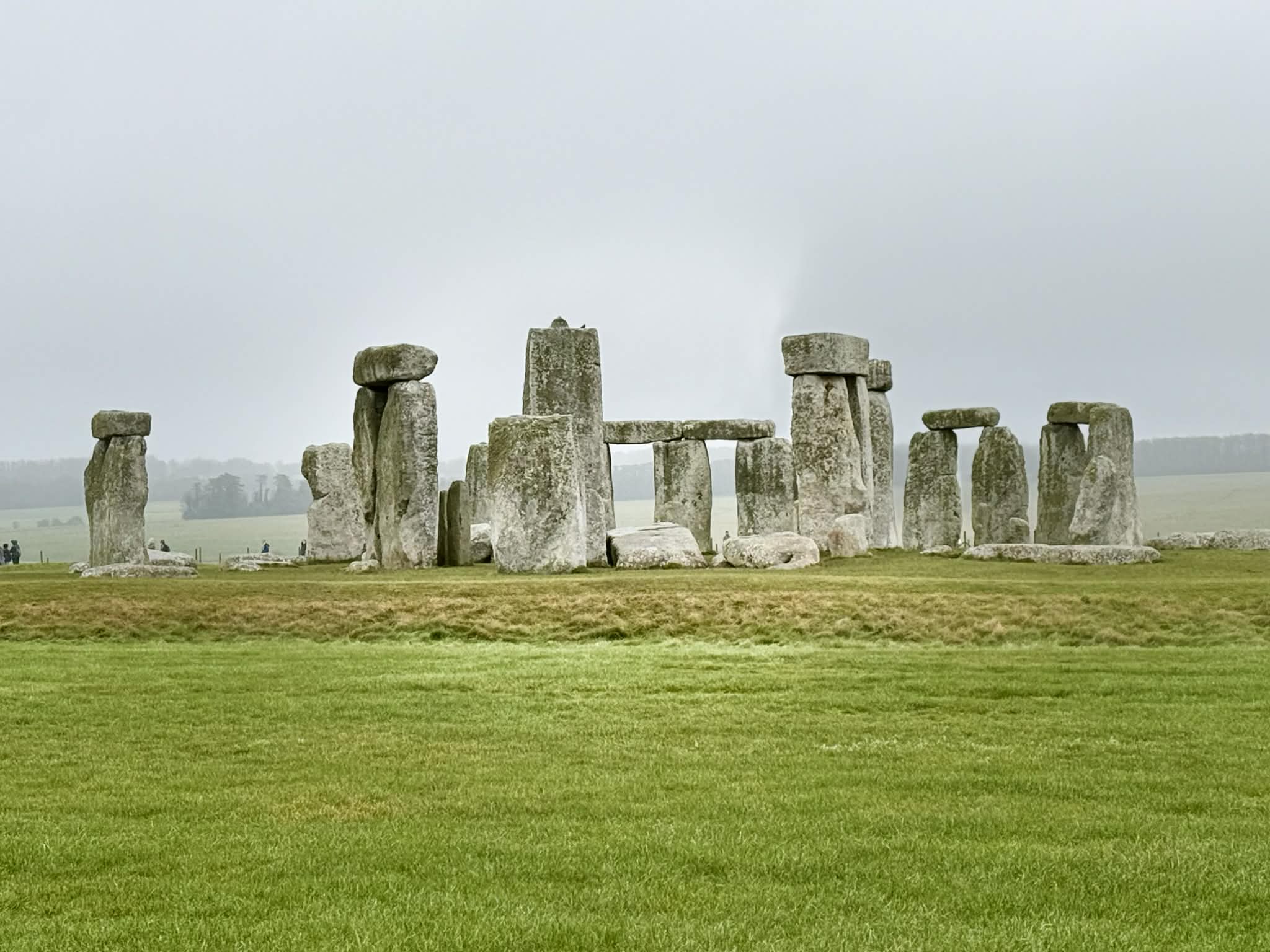
The sun was rising over the stones in a riot of color; lavender, pink, and strawberry; bold orange streaks painted the sky outside the open flap of Maya’s tent. She sat cross-legged on the earthen floor; palms open to accept the familiar comfort of the vibrations humming just beneath her fingertips. She gratefully accepted the energy that flowed into her body, preparing her for what was to come. The day ahead would be a difficult one. There were storm clouds on the horizon, but not the kind that brought the much-needed harvest rains. Rather, these clouds were gathering within the groups of men in her community who wanted a larger voice in what would come next for her people. She had heard the rumblings of a revolt; she just didn’t know exactly when it would occur. She was waiting for a sign from those who’d come before her, a vision of the future to guide her on the shaky road ahead.
Clothed in her finely embroidered white linen caftan, adorned in a dozen bronze bracelets on one arm, hammered gold earrings hanging from each lobe and rings with topaz and quartz stones on her fingers, her eyes were fixed on the expansive view in front of her. Maya’s long, braided, silver hair was wrapped tightly around her head like a crown; her unlined skin masked her true age, which only she knew and kept as a closely guarded secret. She was old now, having lived long past fifty years on Mother Earth, and each day that she still woke she considered a gift from her benefactor. She was grateful for the chance to do the work she’d been charged with; for most of her life she had led her people in the massive building project that her ancestors had set forth for them. The stones stood, proud and mighty in the middle of the field and she drew in a deep breath, hoping to draw strength from their strength. The responsibility was staggering, the tasks never-ending, yet she at no time considered a different path. Maya believed in the importance of fulfilling one’s truest destiny, and this monument and protecting the lives of these people was hers.
She had spent today’s pre-dawn hours meditating after a particularly difficult night filled with disturbing dreams. She was attempting to avoid one of the powerful headaches that seemed to plague her, but she realized that it was a losing battle. The pain at the base of her skull was building and she knew better than to fight it. It would consume her for several hours and then fade away as it always did. This was a pattern that she was familiar with, as it had been happening to her all her life. Like her mother and her mother’s mother before her, all great women and powerful leaders, they suffered the same affliction. But a woman’s pain was the very thing that gave her the will to lead; women understood better than men that out of great discomfort came the wisest decisions.
Maya’s oldest daughter Marah suffered as well, and in her heart, Maya knew the great burden her child would shoulder in the future – that was, if her people still had a future, if she could find a way to quell the uprising that was simmering on the edges of their community. The pain in her head was building now in its predictable pattern, mimicking the vibrations under her the earth beneath her. Perhaps, she thought, with it would come the vision she desperately needed. She closed her eyes and thought about the generations of her people who had worked to fulfill the mission of their predecessors, as the stones they had placed in the wide-open field before her stood tall in the brightening sunlight. These boulders, carried on the backs of multiple men from a distance most would never travel in a lifetime, were a testament to the will of those who came before her. Many had died in the building process, some crushed to death under a falling piece of rock, others fatally sliced in half by sharp tools, and Maya knew that these brave soul’s ultimate sacrifice for the collective good was not in vain. While there was still much to be done moving forward, Maya had a premonition that her own time here in this place was now limited.
More pressing on this day, however, was this knowledge that there was a certain unrest building among some of the men in their community. Marah had confided in her mother, telling her of an overheard conversation at the fire pit, the angry words a group of the men had expressed in their secret meetings along the rim of the cornfields. But even without Marah’s words, Maya had known in her heart that this day was coming. She heard it in the late-night whispers beyond her tent and in the shadowy remembrances of her dreams. She knew that it was up to her to find a way forward and that she had limited time to complete this enormous task. For the first time in her life, Maya felt a chill of fear that kept her skating along the surface of her nerve endings, constantly waiting for the inevitable end of times to appear.
“There are rumblings, mother, Marah had said one morning after meditations. “I heard the one named Jason say that it was time the men had more of a say in what we are doing here. That it isn’t right to allow the women to decide the fate of the project.”
“Doesn’t he know that it’s the will of the ancestors? That we’re only following the teachings left to us by the ones who have come before?”
“He doesn’t care. He’s spreading these words throughout the community, and he’s convinced a good number of the men that he’s right. I’m afraid of what he’ll do next.”
Maya knew that she’d need to help Marah confront this problem sooner rather than later, but for now, it would have to wait.
The waves of pain had begun to build in intensity, traveling from the base of her neck upward toward her temples. She sat back and allowed them their due, all the while knowing that what she was experiencing should not be feared, but instead, respected. It was the only way to make it through to the other side of the pain, to her recovery. Maya let the pounding rhythm in her head wash over her and waited for the visions that often accompanied this terrible ache to reveal themselves to her. Perhaps the answers she desired would make themselves known to her today. If that were to happen, it would make this discomfort much more tolerable. If that were to happen, her sacrifice would be worth any amount of pain she was forced to endure to ensure a path forward, to guide Marah with a way to lead their people into the future. At least that was her hope. Perhaps at the other end of her pain, she’d know what was to come next. But for now, she closed her eyes and did the only thing she knew to do; she allowed the headache to have its way with her.
Graduate Housing, Columbia University
August 2025
Miriam Buckley slowly opened one eye and then the other, narrowing them and squinting in the direction of the lone window in her bedroom. A seam of light separated night from day at the horizon. She knew that it was early, but once she was awake, there was never the chance that she’d fall back to sleep. At least last evening she’d been spared the bizarre dreams she’d been experiencing for months, shadowy figures crossing great expanses of open fields, seemingly searching for something she couldn’t place. She almost felt as though she belonged there, that’s how real it felt. There were tents surrounding a large plain, each with a fire pit, food simmering in clay pots above the flames. She could smell the spices in the air – cumin, rosemary, thyme, and the pungent scent of garlic mixed with the unmistakable aroma of roasted root vegetables. Women moved with purpose, each with a job to do. And, of course, the massive stones towered over all of it, set in a circle, heavy and commanding. She felt very much a part of this sisterhood, in fact, she had a sense that she sat at its center. It’s the research, she thought. It’s slowly driving me mad.
She rubbed her cheek against the scratchy pillowcase, waiting to feel that familiar ache at the base of her skull, dreading the hours she might need to spend in a dark room with a cold washcloth over her eyes. Thankfully, it wasn’t there today. At least not yet. Her migraines were unpredictable. While she had some warning before one struck, she never understood what caused them in the first place, only knowing that they seemed to plague the women of her family. Miriam’s earliest childhood memory was being shushed by her father during one of her mother’s bouts. She and her younger brother Henry would need to play in absolute silence until the headache passed and her mother would finally emerge from her bedroom, pale and shaky, her nightgown drenched in sweat. All would be fine again, or at least until the next headache struck and the pattern repeated. Her mother had tried some of the prescription migraine medicines, but they made her feel worse; dizzy, nauseous and loopy for hours.
Miriam shifted into a sitting position, reminding herself that this single bed in her sparse dorm room didn’t leave much space for movement. She longed for the day when she’d finally have her own apartment again but as a graduate fellow living on a tiny grant, that wouldn’t be anytime soon. She was doing important research and had made some headway toward her dissertation, but she was not yet close to being financially independent. And after her disastrous break up with her long-time boyfriend and almost fiancé Brendan, she made a promise to herself that there would be no more living with another man; as a whole, men were needy and brought another set of troubles to her door. She shuddered at the thought of the mistake she’d almost made, marrying someone who didn’t respect her work, who expected her to support his research and only humored her as she plodded her way through her own reams of papers, textbooks and historical documents. While it was true that she spent hours lost in thought, sifting through a myriad of ancient artifacts, mired in a lost time before there was any written history, it was her passion. Her work was as important for her as it was for Brendan’s study of the Industrial Revolution. They shared a passion for history, but as it turned out, that was the extent of their common ground. She was relieved when an opening came up in graduate housing and she was able to move out of his tiny railroad-style apartment in Brooklyn that past winter. She would miss the sex, but that was about all.
She had bigger problems to deal with. Every time Miriam felt like she was just about to breakthrough and uncover the one missing piece that would snap the puzzle into place, she hit a wall. She had postponed her defense twice now. She shuddered at the memory of the very tough conversation she recently had with her mentor and chair of the dissertation committee, Dr. Matthias Solomon.
“This is it, Ms. Buckley,” he had told her in his cramped office, dusty books lining the shelves and sitting on every available surface. “You have one last shot at getting your degree. This is the last extension I can grant you,” he had told her plainly.
Without meeting her current deadline date, Miriam would no longer be a PhD candidate at Columbia University. She had been given all the leeway possible; there were no more extensions to be had. The pressure she felt was enormous, and the debilitating headaches she suffered as a byproduct did not help.
Standing now on unsteady feet, Miriam thought about the place that was currently the center of it all — Stonehenge. She had been mesmerized by the ancient structure when she had first visited the site as an undergrad and had based her entire academic career on the theory that the massive monument on Salisbury Plain was engineered by women. It was almost blasphemy, her supposition, but she felt deep down in her soul that she was right. She still hadn’t found the proof to substantiate her theory, and everything pointed away from what she believed to be true. Her male counterparts had argued that she was not dealing with the basic facts — how could women have moved those enormously heavy stones? Were they some sort of freakishly strong aliens? Had they come up with a mathematical equation to engineer a way to hoist the massive boulders up, to secure them deep within the ground that was lost to time? And most importantly, and what she couldn’t figure out yet, but what she was trying to uncover, was why these women seemed to be erased from the history of the place.
She’d been back countless times and was about to head off to England again, this time to Oxford, to study some of the documents in their extensive library. She had applied for a grant that would allow her to teach a seminar on her findings to date in exchange for room and board for a semester, and luckily, she had been permitted that request. She had to find the key as her final dissertation defense date was set and was now only six months away. Miriam still had more questions than answers, plus, she owed her grandmother a visit. While Miriam had grown up in the United States, her maternal grandmother Marjory still lived in the Cotswolds, in a small village not far from the fabled university, and Miriam had promised her mother that she’d check in on the older woman during her stay there. That was, if she could find the time. The clock was ticking, and she had not a moment to waste.








Recent Comments